
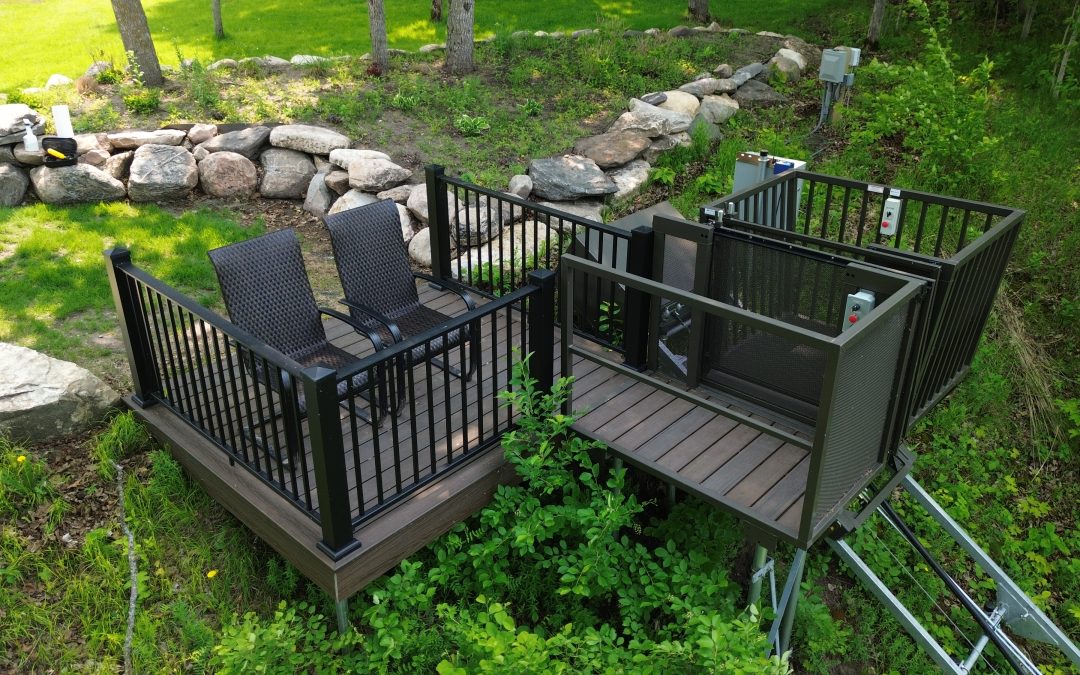
If you’ve been searching for hillside tram cost, you already know the standard non-answer: “It depends.” That’s technically true, but it’s also a cop-out that doesn’t help you make a decision. This post breaks down every factor that actually moves the price, so you can walk into a conversation with a realistic picture of what you’re looking at.
Marine Innovations has been engineering and installing hillside trams, hill trams, and incline systems across the country for decades. Every project is custom. And while we won’t publish a price sheet (because a price sheet built for your neighbor’s bluff tells you nothing about yours), we can tell you exactly what drives the number.
What Is a Hillside Tram, Exactly?
Before getting into cost, it’s worth clarifying terms, because buyers search for this system under a lot of different names. A hillside tram, hill tram, incline tram, and hillside lift are all variations of the same idea: a motorized car that travels along a fixed track up and down a steep slope. Some people call it a funicular, which is technically accurate for cable-driven systems. Others search for incline elevator or outdoor lift.
Whatever you call it, the function is the same: it solves a steep terrain access problem that stairs can’t, or shouldn’t, solve anymore.
The Factors That Determine Hillside Tram Cost
No two hillside tram installations are identical. Here’s what actually affects what you’ll pay:
- Total elevation change and track length
This is the single biggest driver. A 60-foot system is a fundamentally different project than a 200-foot system. Different drive systems means more material, more engineering, and more installation time. The steeper and longer the run, the more the system needs to handle, structurally and mechanically.
- Terrain complexity
A clean, open slope is the easiest scenario. But most hillside properties aren’t clean or open. Rocky outcroppings, tree roots, erosion, irregular grade changes, or existing landscaping all affect how the track is engineered and how the installation crew works the site. Wooded bluffs, common on lake properties, add complexity but are absolutely workable. That said, complexity has a cost.
- Site access for installation
Marine Innovations custom-engineers every system, which means the crew needs to actually get equipment to your site. Properties with limited road access, narrow lots, or difficult staging areas take more time and more creative problem-solving. Remote or rural locations can also affect logistics.
- Car size and capacity
What are you moving? Just yourself and a bag of groceries? Or are you hauling kayaks, and a full cooler? The size and load rating of the car, and the motor spec that drives it, will scale with what the system needs to handle. A larger, higher-capacity system costs more than a basic model.
- Track configuration and anchoring
Some terrain calls for a straight run. Others require curves, intermediate supports, or specific anchoring solutions depending on soil type and slope stability. A geotechnically complex hillside may require engineered footings that a straightforward install wouldn’t.
What’s Included in the Price
A hillside tram from Marine Innovations isn’t a product you buy off a shelf and assemble; it’s a custom system. The price reflects:
- Site assessment: We come to your property, evaluate the terrain, and determine exactly what your system needs before a single component is ordered.
- Custom engineering: Every track, car, and drive system is designed for your specific elevation, terrain, and use case.
- Professional installation: Our crew handles the full install. This isn’t a contractor-friendly kit. It’s a precision installation.
- Ongoing service: We service what we build. That relationship doesn’t end at installation.
When buyers compare hillside tram cost to other terrain access solutions, they’re often comparing a custom-engineered, professionally installed system against human built stairs or a non-compliant incline lift. The comparison rarely holds up.
Why There’s No Published Price
Some companies post starting prices. We don’t, and it’s not because we’re hiding something. It’s because a number pulled from a different project on different terrain in a different state can do real damage to your decision-making. A “starts at” figure on a shallow-grade install in a southern climate tells you nothing about what your 180-foot bluff on a Midwest lake is going to cost.
The fastest path to a real number is a free estimate. It’s free. It takes the guesswork out completely. And unlike a price list, it’s actually accurate for your property.
Other Terms You Might Be Researching
If you’ve also been searching for hillside lift cost, lake tram cost, funicular cost, or outdoor lift cost, you’re researching the same system. The terminology varies, but the engineering principles and the pricing factors are the same. Marine Innovations builds these, it’s what we do.
The Bottom Line
Hillside tram cost is driven by terrain, not by a catalog. Elevation change, slope complexity, site access, and load requirements are the variables, and they’re different for every property. What we can tell you with certainty: every system Marine Innovations builds is custom-engineered for the specific terrain it serves, installed by our own crew, and built to last.
The fastest way to get a real number for your property is a free estimate. It costs you nothing. It tells you everything.