
You asked two companies for a quote on the same hillside. One comes back noticeably lower than the other. You’re sitting at the kitchen table with both PDFs open, trying to figure out the obvious question: why?
Most of the time, it isn’t because one tram is cheaper. It’s because the two quotes aren’t measuring the same thing. One number includes work the other quietly leaves out — and the place that work hides is a small phrase that shows up on almost every estimate in this industry: by others.
Learn to read that phrase and you can compare any two quotes honestly. Miss it, and the “cheaper” system can end up costing more by the time it’s actually running.
“By others” isn’t a scam, but it is a cost
“By others” is standard contracting language. It simply means this part of the job is not included in this price; you’ll arrange and pay for it separately. It’s normal, it’s legal, and you’ll see it on quotes from reputable companies.
But here’s what matters to your wallet: every line marked “by others” is a cost that’s still coming. It just isn’t in the number you’re looking at, and it won’t come from the company that handed you the quote. You’ll be the one finding a vendor, getting a second price, and managing that piece yourself.
So, the headline total is not the total price of your project. It’s just the beginning. Two quotes are only comparable once you know what each one includes, and what each one pushes to “others.”
The real cost categories in a hillside tram project
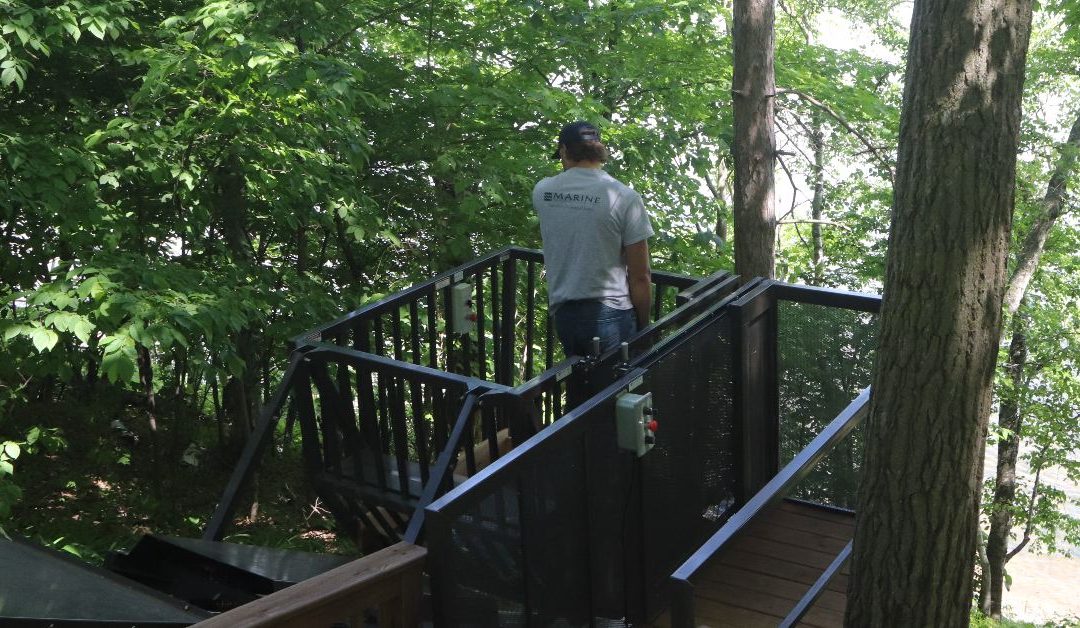
A hillside tram (also called an inclined elevator or hillside lift) is a bigger project than the equipment alone. Here are the cost categories that make up the whole job. On any quote you receive, find each one and ask the same question: Is this in the price, or is it “by others”?
Engineering. Several states require stamped engineering for the permit. That’s a real cost with a real number. Ask whether it’s included in the quote or listed separately.
Site preparation and foundations. The system has to anchor into your specific hillside, soil, slope, and footings all factor in. Ask whether foundation work is scoped into the price or treated as a separate trade.
Installation labor. This is often the single largest “by others” line, and the one buyers underestimate most. Installing a tram on a steep grade is skilled, multi-day work. If complete labor isn’t in the quote, you are responsible for sourcing and paying a crew capable of doing it safely.
Travel and accommodation. Crews don’t always live near your lake. If the quote doesn’t include travel and hotel accommodations, those costs land on you on top of labor.
Landing platforms and gates. There are structures you step on and off at the top and bottom. Some quotes assume you already have suitable decking; some build it. If you don’t have existing structures, find out who’s responsible for them. Mounting and wiring the landing gates is an additional and required step.
Shipping and delivery. Getting the equipment to your property. Ask whether freight is in the number.
Permitting. This one is honest to flag plainly, because it’s the line where almost no company can include everything, and that includes us. Read the next section carefully.
The honest part: some costs land on you no matter who you hire
A transparency checklist is worthless if it pretends the company writing it is perfect. So here’s the straight version.
Permitting is the cost that can be hardest to fully lock in upfront, and you should expect some of it to fall outside the quoted number regardless of which company you choose. State permit and inspection fees often get assessed at final invoice rather than baked into the estimate, because the exact amount depends on the authority. And local permits are frequently the homeowners to pull, that’s true on our estimates too.
That’s not a gotcha. It’s the nature of permitting, and any company telling you they’ve fixed every permit cost to the dollar before the job starts, might be overpromising. What you can ask is specific: which permits does this company pull on my behalf, which ones are mine, and roughly what should I budget for the ones that get assessed later?
If a quote is silent on permitting entirely, that’s the answer that should worry you, not the one that’s honest about it.
How to compare two quotes’ apples-to-apples
Put the two estimates side by side and run the same pass on each:
- Write down the headline total for each.
- Go line by line and mark every “by others,” every “allowance,” and every cost noted as assessed later or to be acquired by the homeowner.
- For each marked item, estimate what it will actually cost you to arrange separately, labor and engineering especially, since those are the big ones.
- Add those back to the headline total.
- Make sure every included item, responsibility, and excluded cost is clearly identified in writing so there are no surprises later.
Now you have two real numbers, and you can finally see which project is actually less expensive, and which one just had a smaller front page.
Nine times out of ten, the gap between the headline and the real total is wider on the quote that looked cheaper. That’s not a coincidence. A lower number is easier to win a signature with; the rest arrives after you’ve committed.
Ask us the same questions you’d ask anyone
We’d rather you run this checklist on our quote than skip it. Engineering, installation labor, and travel are inside the number we hand you, not pushed to “others”, and we’ll tell you plainly which permit costs will land separately and roughly what to budget for them.
So, get the other quotes. Read every line. Hunt for “by others.” Then bring us the questions, and we’ll walk through ours with nothing hidden behind a smaller headline.
See our full breakdown of How Much Does a Hillside Tram Cost? What Actually Drives Price? for the equipment side of the equation.